
diagonal splicing process
meaningThis method involves beveling and splicing the boards together to create a seamless transition effect, suitable for wood veneer, flooring, or wall decoration.
Process characteristicsPrecise control of the bevel angle (usually 45 degrees) is required to ensure tight joints. The bevel cutting process of the integrated home aesthetic woodwork, combined with PUR hot melt adhesive veneer technology, improves the bonding strength and efficiency.
AdvantagesIt reduces gaps caused by traditional splicing, improving overall aesthetics; it adapts to irregular space designs, enhancing visual expansiveness.
Sandwich process
meaningA "sandwich" structure is formed by stacking three layers of boards of different thicknesses (such as 9mm + 18mm + 9mm) for use in cabinets or wall decoration.
Process characteristicsThe middle layer typically serves as a supporting structure, the surface layer emphasizes texture, and the bottom layer enhances stability. Applying this technique can enhance the cabinet's sense of layering and its linear contours.
AdvantagesEnhance overall structural strength and reduce the risk of deformation; enrich visual layers and adapt to the high-end customization needs of large spaces.
Milling process
meaningUsing a milling machine to cut the surface of sheet metal to create invisible handles, grooves, or curved shapes, commonly seen in cabinet doors, Roman columns, etc.
Process characteristicsHigh-precision cutting is achieved through CNC equipment, such as the J-shaped full-length handle with a handle-free design. Combined with wood veneer veneer technology, the natural wood grain is preserved.
AdvantagesThe design is simplified to fit the minimalist style; the exposed hardware is avoided to enhance the overall aesthetic.
skeletal lines
meaningSkeleton lines are a decorative structural design style for cabinet furniture, typically used in kitchen cabinets, sideboards, wardrobes, and bookcases.
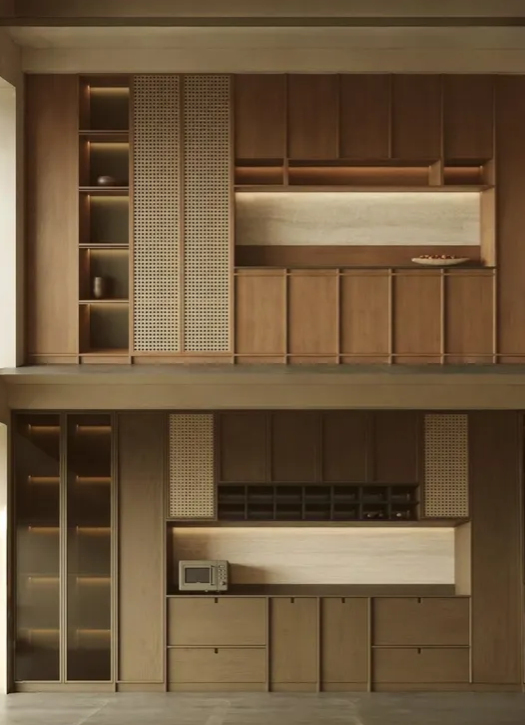
Process characteristicsHighlighting the frame lines of the furniture creates a visual effect that is both simple and three-dimensional, much like the skeleton of the furniture.
AdvantagesCombining aesthetics and practicality, it can be used as a handle for door panels or drawers, reducing the need for additional hardware and making the overall design more integrated and minimalist.
Grooving process
meaningLongitudinal or transverse grooves are cut into the surface of the board, which is often used in the design of background walls, cabinet doors or wall panels.
Process characteristicsThe depth and spacing of the grooves need to be adjusted according to the proportion of the space, and can be combined with lighting design to enhance the layers of light and shadow.
AdvantagesEnhances the sense of three-dimensionality and spatial depth; suitable for modern and industrial style interior design.
Arc process
meaningThis technique involves bending wood to soften sharp edges and corners, and can be used for corners, door frames, and shelf edges.
Process characteristicsThe material is made of multi-layer board or MDF substrate through hot pressing to ensure a smooth and natural curve. The rounded corners balance safety and aesthetic appeal.
AdvantagesReduces collision safety hazards, especially suitable for families with children; enhances the flow of spatial lines, suitable for modern minimalist or classic elegant styles.
Begonia corner craftsmanship
meaningBegonia corner is a decorative technique that uses a 45-degree beveled angle to create a begonia-petal-like effect. It is often used in wood veneer, cabinet door edges, and mortise and tenon structures.
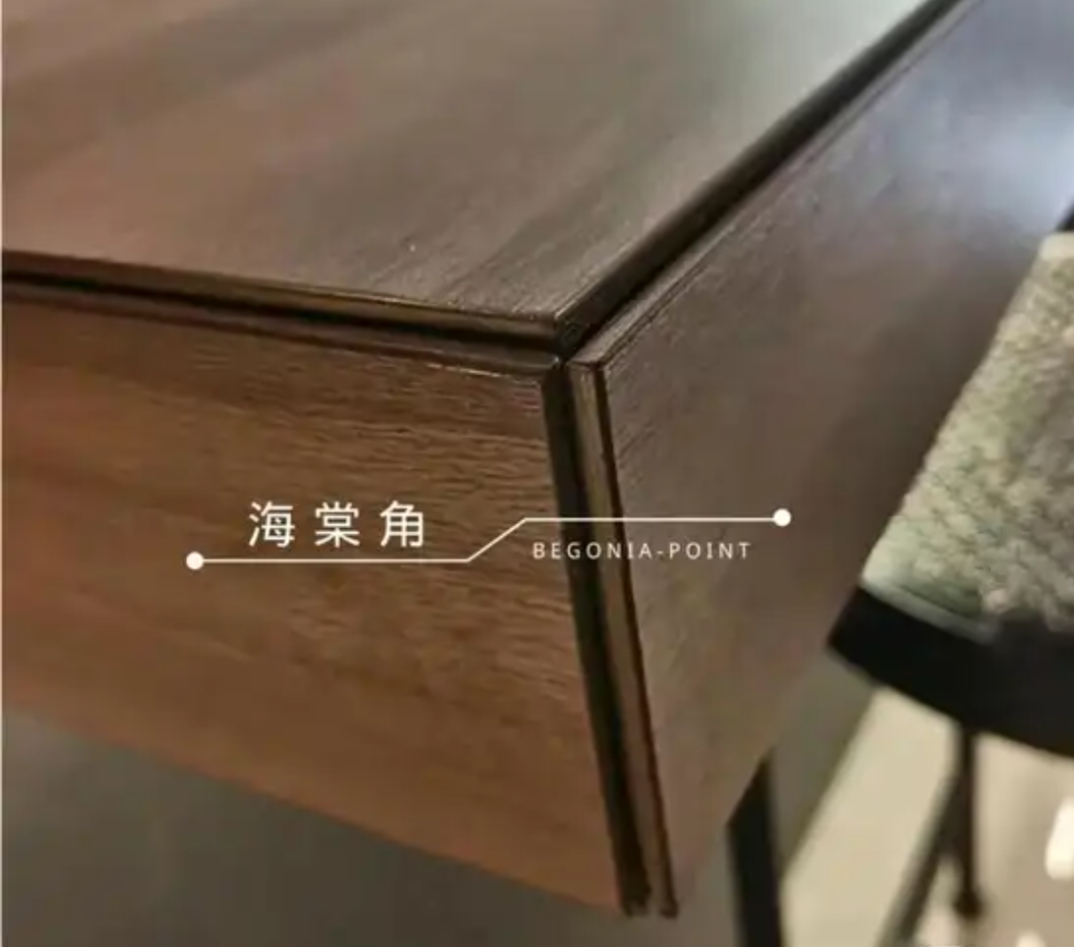
Process characteristicsSeamless connections are achieved through precise cutting and splicing, reducing dust accumulation in gaps. Combining traditional mortise and tenon joints enhances connection stability; for example, the mortise and tenon joint technique for wood veneer showcases both traditional craftsmanship and aesthetics while improving structural strength.
AdvantagesEnhances the sophistication and refinement, suitable for minimalist or understated luxury style interior design; avoids wear and tear on right-angled edges, extending the lifespan of furniture.
Grille process
meaning: A grid element formed by parallel or intersecting lines, used in wall, cabinet door or partition design.
Process characteristicsMade of paint-free multi-layer board or solid wood, with corner grille trim strips for a natural connection, and rounded corner grille strips combined with arc technology to enhance safety.
AdvantagesEnhances spatial layering and lighting effects; simplifies cleaning and maintenance, and avoids paint wear issues.

 Chinese
  English